Helical piles
- Fast installation with no curing delay
- Minimal excavation and displaced soil
- Immediate structural capacity
- Useful in wet, sloped, or tight sites
- Year-round installation flexibility
Foundation Comparison
Compare installation speed, excavation, weather, cleanup, and project fit before choosing a foundation system.
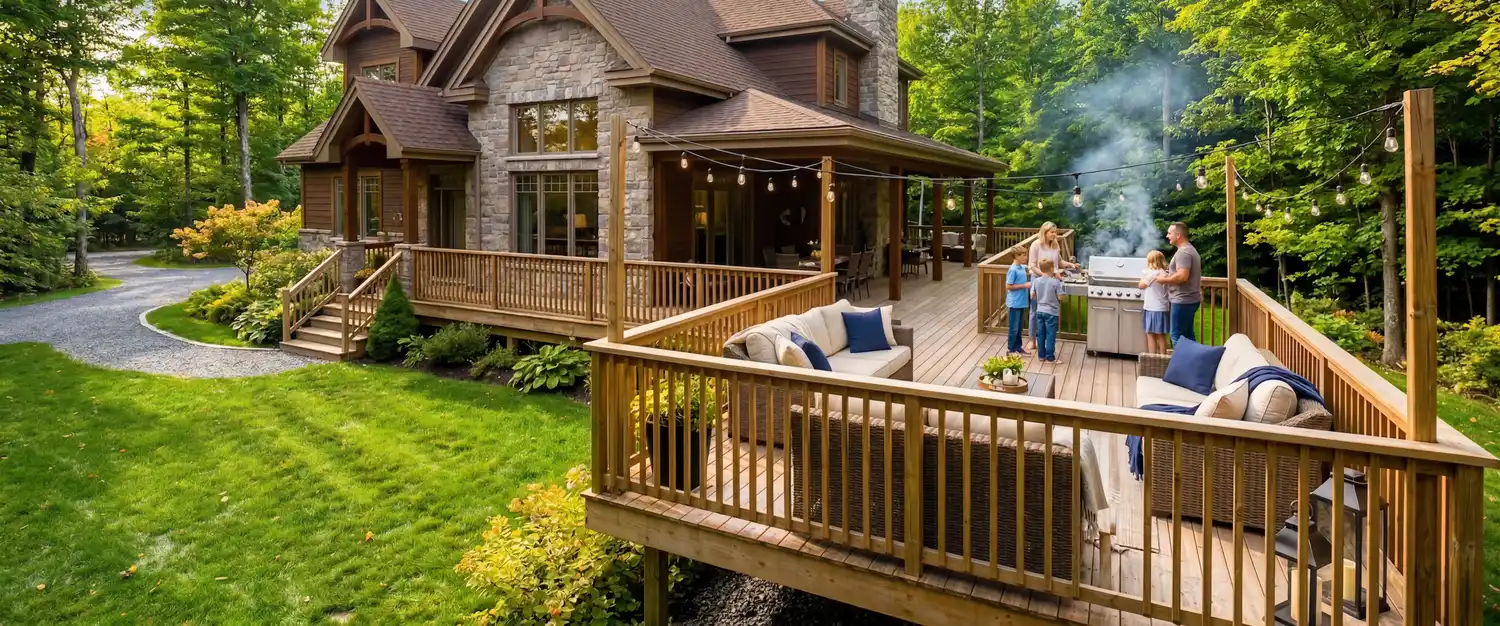
Built with purpose
Concrete remains appropriate for basements, large slabs, and many traditional builds. Helical piles are often advantageous for decks, additions, porches, boardwalks, tight access, wet areas, and projects where speed matters.
The right decision depends on the structure, soil, access, engineering, schedule, and total installed scope—not just material price.
Piles can reduce forming, delivery, and curing time.
Compact equipment and minimal spoil protect finished properties.
Compare excavation, labour, cleanup, delay, and restoration—not material alone.
Making the comparison
Concrete and helical piles can both form strong foundations, but they reach that result differently. Concrete work commonly involves excavation, spoil removal, forms, reinforcement, delivery, placement, curing, cleanup, and landscape restoration. Helical pile installation uses compact hydraulic equipment and creates immediate structural support.
For decks, additions, porches, boardwalks, wet ground, slopes, and tight residential sites, reduced excavation and schedule certainty can make screw piles particularly attractive. Basements, large continuous walls, and some slab systems may still require poured concrete. Engineering and site conditions should guide the final choice.
Frequently asked questions
Not always. Compare total installed costs, including excavation, labour, curing delays, cleanup, and restoration.
Proper installations extend below frost-affected soil and are designed to maintain stable structural support through seasonal conditions.
Concrete may be required for basements, large slabs, continuous foundation walls, or designs specifically engineered around poured systems.
Get in touch
Your local Postech team for foundation, excavation, slab, and deck projects across Burlington, Oakville, Milton, Halton Hills, and surrounding communities.