Pile Foundations in Halton: A Homeowner’s Guide
Choosing a foundation is one of the most important decisions in any construction project. The structure above can only perform as intended when the support below is designed for the loads, site conditions, and way the building will be used.
For homeowners and builders across Burlington, Oakville, Milton, Halton Hills, and the surrounding Halton Region, screw piles—also called helical piles—can provide an efficient foundation option for decks, additions, sunrooms, porches, accessory buildings, and other suitable structures. They are not automatically the right answer for every property, but they are worth considering when access, excavation, scheduling, or variable ground conditions make conventional footings more difficult.
This guide explains how pile foundations work, where they are commonly used, and what information a project team should review before installation.
What is a pile foundation?
A pile foundation transfers structural loads through weaker or less suitable material near the surface to soil capable of supporting the project’s design loads. Different pile systems accomplish that in different ways. Driven piles are forced into the ground, bored piles are constructed in drilled holes, and screw piles are mechanically rotated into the soil.
A typical screw pile includes a steel shaft with one or more helical plates. Hydraulic equipment applies downward pressure and rotational force while the pile advances. The installer monitors depth, alignment, and installation torque according to the selected system and project requirements.
Once the required criteria are satisfied, the pile is completed at the required elevation and fitted with a bracket, cap, or other connection for the supported structure. You can learn more about the installation sequence in our guide to how helical piles work.
Why Halton projects use screw piles
Halton includes mature urban neighbourhoods, newer subdivisions, rural properties, sloped sites, waterfront-area construction, and homes with carefully finished landscaping. Those settings create different foundation challenges. A tight Burlington side yard will not have the same access as a rural property near Milton, and an Oakville renovation may require more coordination around existing structures and landscaping.
Screw piles can reduce the amount of open excavation and concrete handling required for suitable projects. Compact installation equipment may also help teams work around existing yards, fences, and buildings. Because the pile itself does not require a concrete curing period, subsequent work may be able to proceed once installation, documentation, and any required inspection or design review are complete.
Those are potential advantages, not guarantees. Equipment still needs a safe access route and working clearance. Underground utilities must be located. The project may require engineering, permits, conservation approval, or inspections. Actual installation time and depth depend on the pile layout, soil response, access, weather, and project scope.
Common residential pile-foundation applications
Screw piles can support many types of residential and light-construction projects when the system is properly selected and detailed. Common applications include:
Backyard decks, covered decks, porches, stairs, and landings
Home additions, extensions, mudrooms, and sunrooms
Garages, workshops, sheds, and accessory structures
Gazebos, pergolas, privacy structures, and outdoor kitchens
Walkways, small bridges, boardwalks, and specialty structures
Foundation underpinning designed to support an existing structure
The pile configuration must follow the structure. A small open deck and a roofed deck do not create the same loads. Stairs, privacy walls, roofs, hot tubs, and outdoor kitchens can introduce concentrated, lateral, wind, snow, or uplift forces that need to be considered during design.
Deck footings are a particularly strong fit
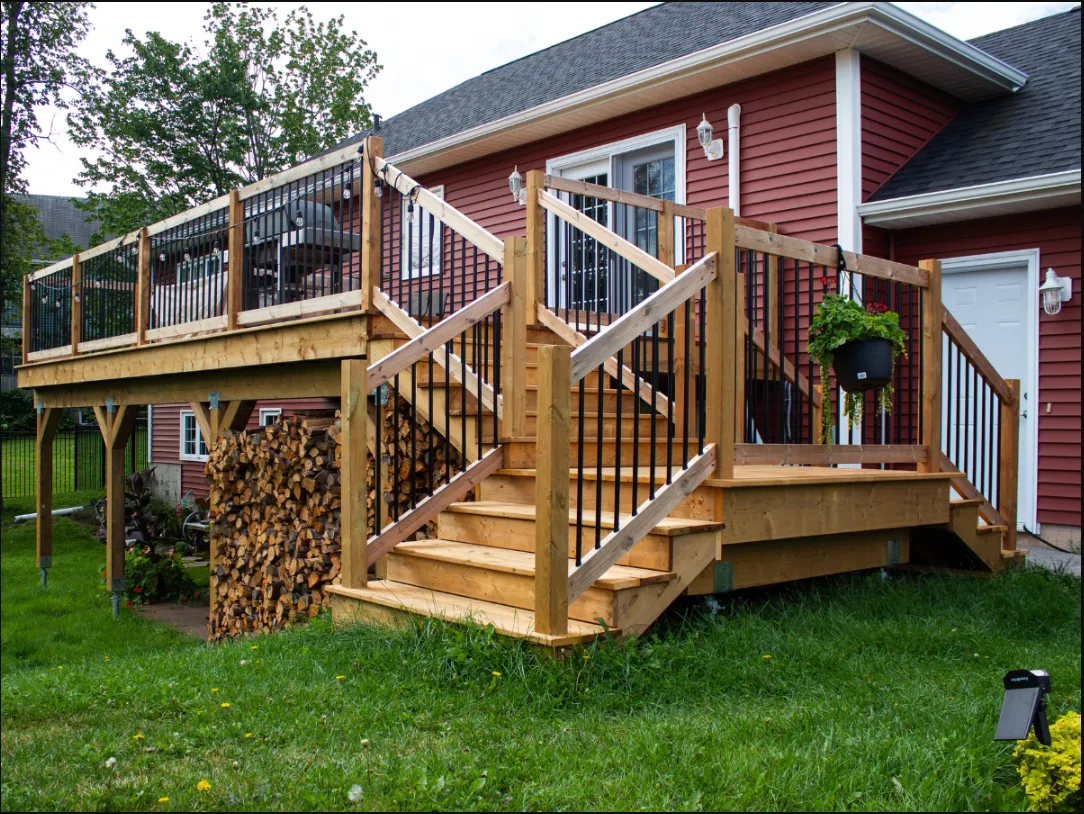
Deck construction is one of the most familiar uses for screw piles in Halton. Instead of excavating and forming a series of concrete footings, piles are installed at the designed post or beam locations and completed with connections suited to the framing plan.
This can be valuable in an established backyard where a contractor must work around gardens, patios, pools, fences, or narrow access. It can also simplify scheduling for a deck builder who wants the foundation installed and documented before the framing crew arrives.
Pile count should never be estimated from deck area alone. Beam spans, joist direction, post locations, deck height, stairs, guards, roof loads, and concentrated features all influence the foundation plan. Homeowners and contractors can review our dedicated guide to deck footings and deck piles in Halton before requesting pricing.
What determines screw-pile depth?
There is no universal screw-pile depth for Halton Region. Even neighbouring properties can respond differently because of fill, previous excavation, drainage, changes in grade, or variations in the soil profile.
Final depth is governed by the selected pile system, the structural requirements, installation torque, soil response, and any project-specific engineering or manufacturer criteria. An installer should not promise a fixed depth based only on the municipality or postal code.
Torque can provide useful installation information because resistance generally changes as a pile encounters different material. Its relationship to capacity, however, must be used in accordance with the approved product information, engineering, and installation requirements. It is not a substitute for proper design.
Screw piles and Ontario freeze-thaw conditions
Shallow foundations can be affected when moisture in the active soil freezes, expands, and later thaws. A properly designed pile system extends below that active near-surface zone and transfers loads to suitable bearing material. The pile and connection must also be detailed for the forces that apply to the structure.
It is more accurate to describe screw piles as a foundation system designed to address frost-related conditions than to say they are automatically “frost-proof.” Drainage, grade, pile design, structural connections, and construction quality all remain important to long-term performance.
Screw piles compared with concrete footings
Concrete remains an appropriate foundation material for many projects. The choice is not simply a contest between an old and a new method. It should be based on the structure, site, schedule, access, inspection requirements, and complete installed scope.
Conventional footings may be straightforward where excavation access is open and the soil, weather, and construction schedule suit forming and pouring. Screw piles may be more practical where minimizing excavation, avoiding concrete curing delays, or working in a constrained yard provides a meaningful benefit.
Costs must also be compared carefully. A pile quotation and a concrete quotation may include different work. Excavation, soil removal, forming, concrete, reinforcement, inspections, engineering, backfill, restoration, pile caps, and mobilization should all be considered. Our helical piles versus concrete guide outlines the main planning differences.
Permits and approvals in Halton Region
Using screw piles does not remove municipal requirements. Building permits and zoning review depend on the complete structure, its size, height, attachment, use, and location on the property—not only the footing type.
Municipal processes differ across Burlington, Oakville, Milton, and Halton Hills. Depending on the address, a project may also require grading, drainage, tree, heritage, Niagara Escarpment, or Conservation Halton review. Requirements can change, so homeowners should confirm them with the appropriate municipality before ordering materials or beginning construction.
For city-specific planning information, visit our pages for screw piles and deck footings in Burlington, screw piles and deck footings in Oakville, or screw pile foundations in Milton.
Information to gather before requesting a quote
A useful quotation begins with more than a pile count. Providing complete information early helps the installer identify access problems, missing design details, and responsibilities that could otherwise create delays.
Where available, send:
The project address and type of structure
Site plan, structural drawings, and proposed pile layout
Design loads and connection details
Desired finished elevations
Photographs of the work area and access route
Gate width, overhead restrictions, slopes, and nearby obstacles
Known utility, pool, retaining-wall, or existing-foundation locations
The desired construction schedule
If drawings are not yet complete, Postech Halton can still discuss the project and identify the information required for a more accurate scope.
What happens during installation?
Before installation, the pile positions and access route are confirmed and underground utilities must be located. The equipment is positioned at each pile location, and the pile is rotated into the ground while the installer monitors alignment, depth, and torque.
Extensions can be added where required by the system and site conditions. Once the installation criteria are met, the pile is completed at the specified elevation and fitted with the required cap or bracket. Installation information is recorded for the project team.
The next construction step depends on the approved plan. Some projects can move directly to framing, while others require inspection, engineering review, or confirmation of the installation records before work continues.
Choosing a pile contractor
A qualified installer should be willing to discuss the selected pile system, equipment access, installation criteria, structural connections, documentation, and the limits of their scope. Be cautious with promises of a fixed depth, universal capacity, guaranteed soil conditions, or a standard price that ignores the structure and property.
The contractor should also coordinate effectively with the homeowner, builder, designer, engineer, and municipal inspector where applicable. Foundation work is most successful when responsibilities are understood before the crew arrives.
Plan your Halton foundation with better information
Screw piles can provide a clean, efficient, and well-documented foundation for many Halton decks, additions, sunrooms, accessory structures, and repair projects. Their value comes from matching an engineered product and proper installation process to the actual structure and site—not from treating every property the same.
If you are planning a project in Burlington, Oakville, Milton, Halton Hills, or a surrounding Halton community, contact Postech Halton. Send the drawings, site address, photographs, access information, and desired schedule, and Barry Martin’s team will help identify the next practical step.


