A corner that drops
Rain collects at one end or a chair rocks in the same spot. The footing under that corner has settled.
Deck Repair & Re-Levelling · Halton Region
When one corner of the deck drops, the posts lift each spring or the boards start to tilt toward the yard, the problem is almost always the footings. Postech Halton installs engineered screw piles under the deck you already have, below the frost line, so a sound frame can often be brought back to level and kept.
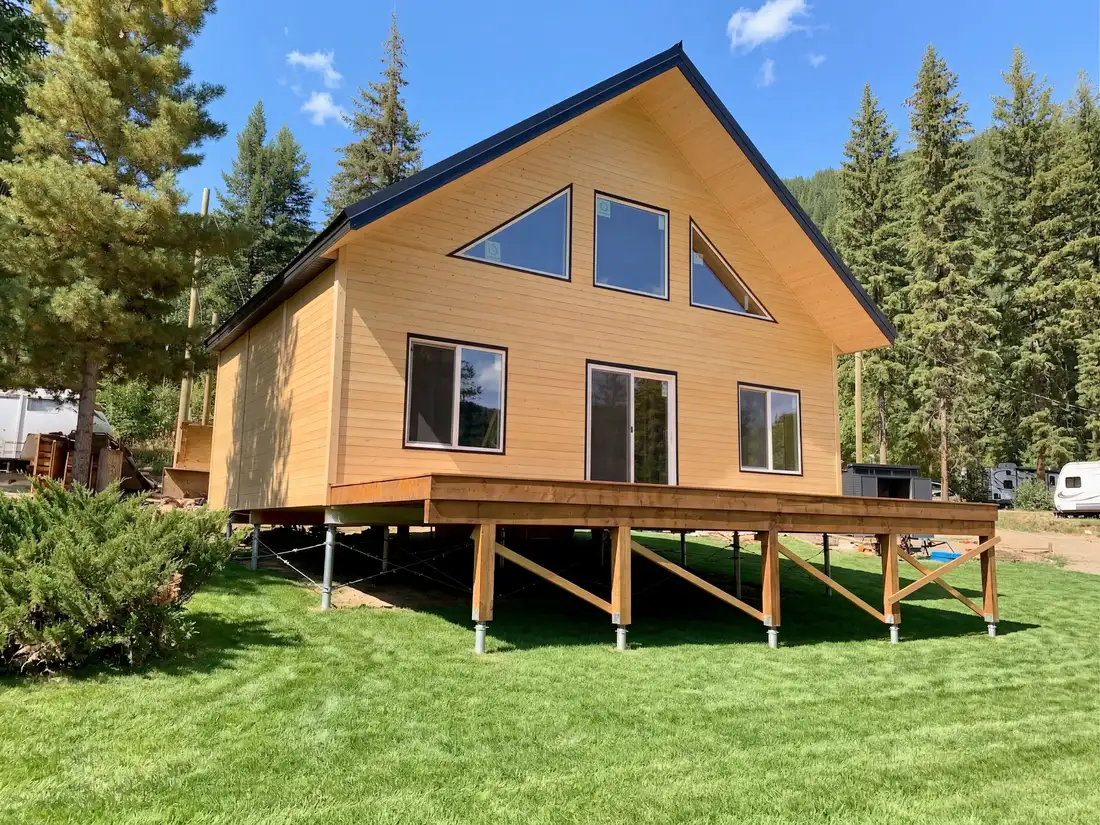
What a failing footing looks like
A deck rarely goes out of level all at once. One pier lifts a little in a cold winter, another settles after a wet spring, and over a few seasons the frame twists to follow them. By the time the railing looks wrong, the footings have usually been moving for a while.
Look at the deck from the yard, then crouch down and look along the posts. Any of the signs below means the footings deserve a closer look. Catching it early matters: a frame that is re-supported while it is still straight can usually be kept, but one left to rack for years ends up with split joists and loose fasteners.
Rain collects at one end or a chair rocks in the same spot. The footing under that corner has settled.
A post sits proud of its pier after winter, or the concrete top is higher out of the ground than last year. That is frost heave.
Daylight shows between the ledger and the wall, or the first board pulls away from the siding as the outer posts move.
Guards follow the frame. When a section leans out or the top rail no longer runs straight, check the post underneath it.
The top tread sits lower or higher than the deck, or the stringers have shifted on the landing pad.
The door sweep catches the boards or the deck now sits above the sill. The deck has moved and the house has not.
Halton ground and frost
A lot of Halton is built on clay-rich ground. Clay swells when it is wet and freezes, and shrinks again when it dries out in a hot summer, so a shallow footing in clay can be pushed up in February and drop in August. Mature trees on older lots in Burlington, Oakville and Georgetown add to the summer drying. Frost can also grab the sides of a smooth concrete tube and lift it even when its base is deep enough.
Newer subdivisions in Milton and north Oakville have a different problem. The soil right beside a new house is backfill from the foundation dig, and it keeps settling for years. A deck pier poured into that loose fill, close to the wall, is one of the most common reasons we see a near-new deck pulling away from the house.
Ontario's Building Code expects deck footings to bear below frost depth. The sample deck drawings in the Town of Halton Hills' own permit guide show concrete piers 1.2 m (4 ft) deep on undisturbed soil. A screw pile reaches past that zone without a hole: the steel shaft is turned down to firm ground and its helical plates hold it against both sinking and lift. Our post on helical piles vs. sonotubes in Halton goes into the comparison in more detail.
How the repair works
We work around the deck rather than taking it apart. The installation equipment is compact enough for most side gates and finished backyards, and it can work close to an existing beam line.
Your photos show the deck height, the post layout and the worst footing. We check what we need on site before the quote is final.
Buried services are located first. Then the beam is shored so the weight comes off the posts and footings that have moved.
Screw piles go in next to the old piers or under the beam line. The installation torque of every pile is recorded.
The frame is jacked back to level and fixed to the new pile caps. Old piers are cut down below grade or left where they are.
Repair or replace
Often only the footings have failed and the wood above them is fine. In that case new piles cost far less than a new deck. If the framing has rotted or was undersized from the start, putting new piles under it only delays the rebuild.
| Part of the deck | Re-levelled on screw piles | Rebuilt on screw piles |
|---|---|---|
| Footings and posts | New piles; damaged posts replaced as needed | New piles under a new frame |
| Beams and joists | Kept and brought back to level | New |
| Deck boards | Kept; any lifted for access go back down | New |
| Railings and guards | Kept, re-plumbed as the frame comes level | New, built to the current Building Code |
| Stairs and landing | Given their own pile where they have dropped | Rebuilt with the deck |
Permits across Halton
Every municipality in Halton runs its own building department, and their deck thresholds are not the same. Burlington, Oakville and Milton require a permit for an attached deck of any size. Halton Hills does not use attachment as the test: there, a deck needs a permit when it is both more than 600 mm (24 in) above grade and larger than 10 m² (108 ft²).
Repair work is where it gets less clear. Milton lists a permit fee for altering an existing deck, and Oakville and Halton Hills both want footing details in deck permit drawings. Whether re-levelling or new footings under your deck needs a permit depends on the deck and the town, and it is the owner's job to confirm before work starts. On lots near creeks, valleys or the Niagara Escarpment, a conservation authority or the Niagara Escarpment Commission may also need to sign off. We supply the pile installation records for your file.
| Municipality | A deck needs a building permit when | Who to ask |
|---|---|---|
| Burlington | It is attached to the house or another structure, a detached deck is over 10 m², it is more than 600 mm above grade, or it has a roof | Building Department, 905-335-7731 |
| Oakville | It is attached to the house (any size), or it is over 10 m² and more than 61 cm above the adjacent grade | Building Services, 905-845-6601 ext. 7377 |
| Milton | It is attached to a building or structure, or it is freestanding and over 10 m² | Town of Milton, 905-878-7252 |
| Halton Hills (Georgetown, Acton) | It is more than 600 mm above grade and over 10 m²; decks 600 mm or lower need no permit at any size | Building Services, 905-873-2600 ext. 2300 |
Building new instead?
If the deck is coming out anyway, our deck footings and deck piles page covers foundation-only work for a new build, and the Halton deck planning guide walks through layout, permits and timing. Town pages: Burlington, Oakville, Milton and the Halton Region hub.
Frequently asked questions
In many cases, yes. If the joists, beams and ledger are in good shape, screw piles can be installed beside the old piers or under the beam, and the frame lifted back to level on them. If the framing itself has rotted or is undersized, a rebuild on new piles is the better use of the money.
Clay-rich soil that swells when it freezes and shrinks when it dries, frost gripping the sides of concrete tubes, and piers poured into loose backfill beside newer homes. Shallow piers and deck blocks are the most likely to move. Screw piles reach firmer ground below the frost zone and their helical plates resist lift.
It depends on the deck and the municipality. Burlington, Oakville and Milton require a permit for any attached deck, while Halton Hills sets its threshold at decks over 600 mm high and over 10 m². Repair and alteration rules vary, so check with your town's building department before work starts. We provide installation records for the permit file.
Yes. If only one or two footings have moved, piles can go in at those posts alone. We will point out any other footings that look like they are starting to go, so you can decide whether to deal with them at the same visit.
The price depends on how many piles the deck needs, its height, how easy the yard is to reach, the soil and whether any posts or framing need replacing. Send us photos of the whole deck and the worst footing for a free quote.
Explore more
Free deck repair quote
Fill in the form with your address and what the deck is doing, then email two or three photos to [email protected]: one of the whole deck, one of the worst post or footing, and one where the deck meets the house. Barry Martin will follow up about next steps.